Everything Is Made of Him
On Krishna, the five elements, and why the argument about whether God exists is the wrong argument.
The question always comes late at night
It happens at every second dinner. Somebody looks at me, at the job I do, at the fact that I spend my days inside warehouses and pipelines and evaluation frameworks, and they say some version of the same thing.
"You're a data guy. How do you still believe in a blue boy with a flute?"
Then comes the second one, usually softer, usually more sincere. "I just can't do the idol thing. Bowing to a piece of stone feels dishonest to me."
For years I argued. I had my verses ready, my counterpoints stacked, my little debate kit. It never once worked. Nobody has ever walked away from a table convinced of God because I out-argued them.
So I stopped arguing and started asking one question instead.
What do you think God is made of?
Most people, believers included, have never actually sat with that question. They picture a man on a throne, or a statue in a temple, or nothing at all, and then they either accept the picture or reject it. Both groups are looking at the same postcard and fighting over whether the country exists.
I want to talk about the country.
Vishwaroop
The moment Arjuna asked to see the real thing
There is a scene in the middle of the Gita that I think about more than any other.
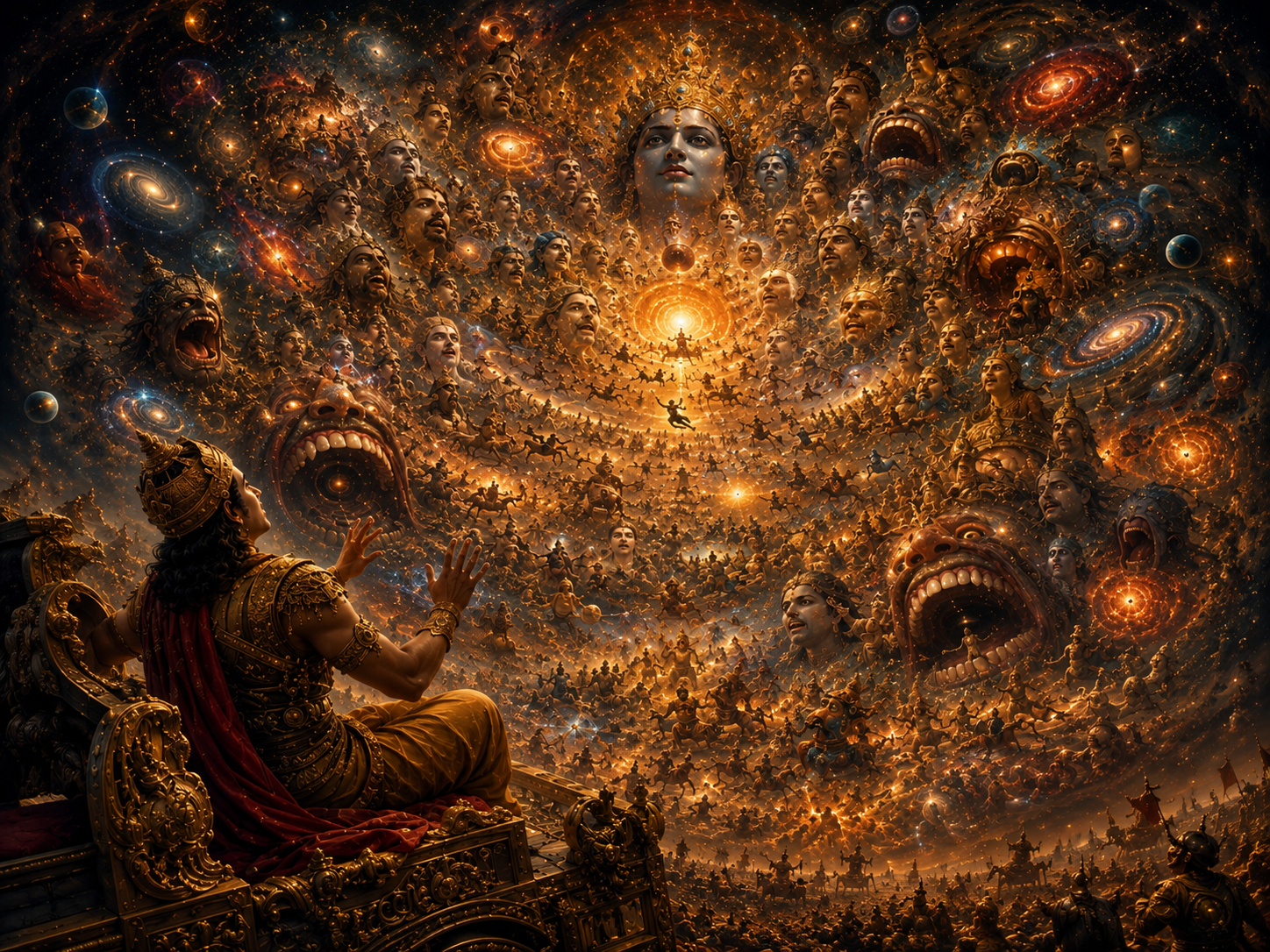
Arjuna has been listening. He has heard the philosophy, the arguments about duty, the whole download. And at some point listening stops being enough. He asks Krishna to drop the costume. Show me, he says. Show me what you actually are.
Krishna tells him something strange before he agrees. He tells Arjuna that he cannot see it with the eyes he currently has. He needs different eyes.
And then the Vishwaroop.
What Arjuna sees is not a bigger man. That is the part people skim past. He does not see Krishna grow to the size of a mountain and become an impressive giant. He sees suns and time and every being that has ever lived and every being that will die, all of it happening at once, with no edges and no outside. Mouths and worlds and fire. Arjuna panics. He begs Krishna to come back into the human shape because the human shape is the only one his nervous system can hold.
Read that scene once and the whole deity question changes.
Krishna was never claiming to be a person who is also God. He was showing that the person was the doorway, not the destination. The flute, the peacock feather, the mischief with butter, all of it is the version that fits through the door of a human mind. It is a compression format. The uncompressed file broke Arjuna in about four seconds.
So when someone tells me they cannot believe God is a man in the sky, my honest answer is: good. Neither can I. He isn't a him. He isn't a her. Krishna is not a body that God lives in. Krishna is what happens when the whole of existence agrees to show up in a form you can love.
Panchabhoota
The five things everything is built from
Our tradition says the material universe is made of five elements. Akasha, Vayu, Agni, Jala, Prithvi. Space, air, fire, water, earth.
I know how that sounds to a modern ear. Quaint. Pre-scientific. A nice thing to say at a yoga retreat.
But sit with it for a minute without the condescension, because these are not a chemistry list. They are five modes of being. Five ways in which reality shows up. And I have never found a single thing, physical or experienced, that isn't some combination of them.
Akasha, the space that allows
Akasha is the one people forget, and it is the most important.
A room is not useful because of its walls. It is useful because of the emptiness inside it. A pot holds water because of the nothing in its middle. Music is not the notes, it is the gaps between them, which is why a flute is hollow and why the sound only exists because something was left empty.
Every call you make crosses it. Every message, every packet, every piece of the internet you have ever touched moved through space that was already there, waiting, asking nothing of you. We did not invent wireless. We discovered a medium that had been sitting there since before there was anyone to notice it.
Akasha is also the space inside you where a thought appears. You do not manufacture your next thought. You watch it arrive.
Vayu, the movement
You will breathe roughly twenty thousand times today. Try to name one of them that you personally arranged.
Vayu is air, but more precisely it is motion. Circulation. The thing that refuses to sit still. Wind on a ridge. The cyclone forming over a warm sea. The oxygen crossing into your blood right now while you read this sentence, doing paperwork you never signed off on.
Your voice is air with a shape pressed into it. Every word you have ever said to someone you love was moving air. Every prayer too.
Agni, the transformation
Fire is the only element that changes things permanently. That is its job.
The sun is a fire that made every atom heavier than helium in your body. The food you ate at lunch is being burned right now in a slow chemical fire so you can sit upright. Your laptop is warm on your legs at midnight because current met resistance. The engine of the cab that brought you home is a controlled series of tiny explosions. The lamp in the temple is fire. The last rite anyone will perform for me is fire.
Agni is Krishna as digestion, as metabolism, as the reason anything becomes anything else.
Jala, the holding
You are somewhere around seventy percent water, which means most of what you call yourself is on loan from clouds.
Jala is what takes shape from whatever holds it, which is a fairly good description of love and a fairly good description of grief. It is the monsoon that decides whether a farmer's year works. It is in the concrete of the building you are sitting in. It is the tea in your hand.
It is also tears, which are the only substance I know of that both sorrow and joy produce in exactly the same form. Water does not distinguish. It just carries.
Prithvi, the ground
Earth is the element of consequence. The one that says: fine, but where does it stand.
Turn your phone over. The lithium was pulled out of a salt flat. The silicon came from sand that spent a few million years being sand. The copper came out of rock in a country you may never visit. The rare earths in the speaker you listen to bhajans on were, not long ago, a hillside.
Every hill I have ever climbed pushed back against my feet. That pushback is Prithvi. It is the element that does not negotiate.
The Test
Press one key and watch what happens
Here is the exercise I give people who tell me God is not present in ordinary life.
Press one key on your keyboard.
The plastic under your finger came from carbon that was a forest before it was oil. Earth. The current that registered the keystroke came from a turbine, spun by steam, boiled by heat, cooled by water. Fire and water. It crossed copper that was mined. Earth again. It travelled as a signal through space. Akasha. The screen lit up because electrons were persuaded to jump, which is fire in the only sense that matters. And through all of it you were breathing, without asking, without thanking anyone. Vayu.
One keystroke. All five.
Now do the same for a phone call to your mother. For a flight. For a hill climb. For a hospital room. For a wedding. For the last conversation you had with someone you have since lost. There is no human act, no machine, no moment of joy or collapse, that is not assembled out of those five.
And if Krishna showed Arjuna that he is not contained in a body but is the substance and the container and the process of everything, then the five elements are not things Krishna made and set aside like a carpenter with furniture.
They are him.
Not his creation. His body, if you want a word for it. Madhav is not watching from somewhere. Madhav is what your keyboard, your breath, your ridge line and your grief are all made out of.
That is the part I want people to sit with. Not a belief. A noticing.
For the Ones Who Say No
I don't think you disbelieve in God. I think you were shown the wrong thing.
I want to be careful here, because I have no interest in scoring points off people who question God. Most of them are more honest than the average person going through the motions at a temple.
But I will say this plainly. When someone tells me God does not exist, and I ask them to describe the God they are rejecting, the description is almost always tiny. A supervisor. A vending machine you put prayers into. A moody king who keeps score. A man with a beard, or a man with a flute, sitting somewhere specific, capable of being absent.
I don't believe in that God either. That God does not survive contact with a single bad year, and most of us have had one.
What I am pointing at cannot be absent, because absence would require a place for it not to be, and space itself is already him. You cannot step outside it to check. The atheist and I are standing in the same field. We disagree only about what the field is made of.
And to the friend who says idol worship feels dishonest, I understand completely. If you think the stone is God in a limited way, that is a small idea. But that is not what is happening.
The murti is not a container. It is an address.
You cannot hug the five elements. You cannot put your head down in front of thermodynamics. Human beings are built to love particular things, faces and names and forms, and a formless truth gives the heart nothing to hold. So the infinite agrees to wear a form so that you have somewhere to put your love. The flute, the feather, the smile of a boy who stole butter. It is not a downgrade. It is generosity.
Arjuna, who had literally just seen the whole universe blazing inside a mouth, asked for the familiar face back. If the greatest archer of his age needed the form, I am not going to pretend I am above it.
Closing
Why I still fold my hands
I have lost people. If you have read anything else I have written here, you know that. Grief did more to my idea of God than any book did.
What it eventually gave me was not comfort exactly. It was scale. The realisation that the air I was struggling to breathe on the worst nights was the same air, that the water on my face and the water in the river were the same water, that whatever had left had not left the field, because there is no outside to leave to. Everything is still here. Rearranged, not removed.
So I fold my hands. Not because I think a stone is listening. Because folding my hands is what a human body does when it finally understands where it is standing.
I press a key and five elements cooperate.
I take a breath and something older than my name does the work.
I climb a hill and the earth holds.
If you are waiting for proof of God, you will be waiting a long time, because you are asking for evidence of something while standing inside it. The evidence is the standing. It is the ground, the air, the heat, the water, the space you are taking up right now. All of it Madhav. All of it already answering.
I do not need Krishna to appear. He already did. He is appearing continuously, in five forms, in everything I have ever touched.

Hare Krishna.